
Supreme Court Justice Ketanji Brown Jackson
Activism in Action

“One person without money, status or a degree can do something that has a major, positive impact on others.”
Supreme Court Justice Ketanji Brown Jackson
From Johnnetta:
I have had the extraordinary privilege of meeting Justice Jackson on an occasion when the National Council of Negro Women honored Justice Brown, the first Black woman to serve on the Supreme Court of the United States. And I treasure the memory of the event in which a group of prominent members of Delta Sigma Theta sorority were photographed with their Soror: the Honorable Ketanji Brown Jackson.
From Snowden:
Justice Ketanji Jackson Brown is such a bright light on the Supreme Court. She has long inspired me, and it is a privilege to share her story with you here.
photo by Lloyd DeGrane

There has never been a time in history when we have needed the wisdom and voices of a women of color on the Supreme Court more. And fortunately, we are blessed to have two at this time, Justice Jackson and Justice Sotomayor. We honor and acknowledge the gifts of both of these women and focus now on the compelling life of Ketanji Brown Jackson, a true changemaker.
The United States Supreme Court building features the phrase “Equal Justice Under the Law.” “Those words speak to Justice Ketanji Brown Jackson’s struggle over the course of her life, including her service on the Supreme Court.
Ketanji Onyika Brown Jackson was born in Washington, D.C., on September 14,1970 to two public school teachers whose own journeys through segregated schools instilled in their daughter a profound sense of responsibility to actively participate in the struggle to move her
country closer to a more perfect union.
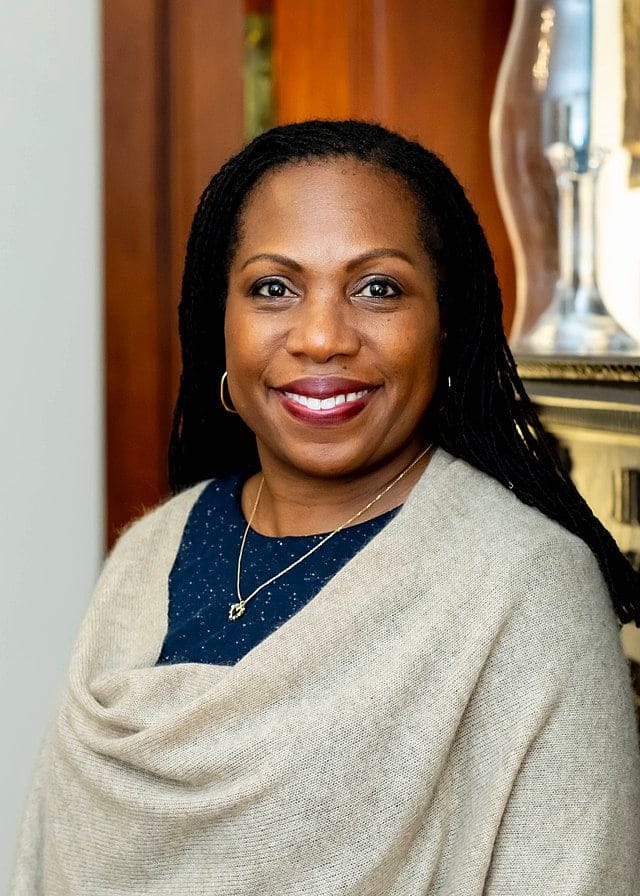
photo of Ketanji Brown at Harvard by Innisfree987
Both graduates of HBCU’s, her parents were deep thinkers and community citizens. They moved to Miami, and young Ketanji Brown watched her father studying for the bar. He later became chief attorney for the Miami-Dade County School Board. Watching him study while she was coloring at the age of four, she was inspired to become a lawyer. Throughout school, she was an excellent student who earned oratory awards and during her high school years, she served as class president. At Harvard University, she began her early social activism, protesting against a Confederate flag displayed on campus and she challenged the low number of Afro-American faculty in Afro-American studies, insisting that the school reflect the promise of inclusion and equity. Her undergraduate thesis, “The Hand of Oppression: Plea Bargaining Processes and the Coercion of Criminal Defendants,” demonstrated her commitment to fairness which would later be evident in her rulings as a judge.
photo below by Kirby Taylor at Essence 2025

Ketanji Brown graduated magna cum laude from Harvard and then graduated from Harvard Law School in 1996, where she was a supervising editor on the Harvard Law Review. She also met and married her husband, Dr. Patrick Jackson, while at Harvard.
Ketanji Brown Jackson’s career included three federal clerkships, culminating with her clerking for Justice Stephen Breyer. While it was unusual for a future judge, Ketanji Brown Jackson served as a federal Public Defender in Washington, D.C., representing clients that included Guantanamo detainees. That experience gave her insight into the legal system’s impact on the lives of her clients and profoundly shaped her judicial philosophy. Judge Jackson also served as vice chair of the U.S. Sentencing Commission from 2009 to 2014, where the body amended federal sentencing guidelines, including reducing sentences for minor drug offenses, as part of broader criminal justice reform efforts.

Judge Jackson’s path to the federal bench began in 2013 when President Barack Obama nominated her to serve on the U.S. District Court for the District of Columbia, where she served for eight years. In 2021, President Joseph Biden nominated her to the U.S. Court of Appeals for the D.C. Circuit, where she served for one year. Her rulings often showed a careful balance between legal doctrine and the lived realities of litigants, illustrating her philosophy that the law must serve both principle and people. Judge Jackson also wrote decisions enforcing federal disability rights protections, such as finding that a jail violated the rights of a deaf inmate by failing to provide reasonable accommodations, and focusing on employment discrimination claims and access to justice for self-represented. As she has stated, “We must not choose harsh words that tear people down. We must choose kind words that lift people up.”
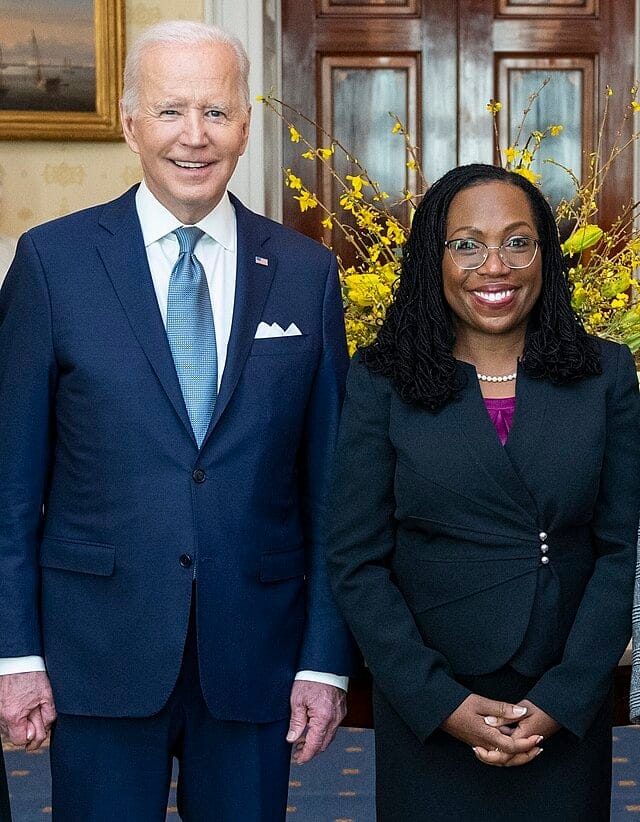
On February 25, 2022, President Joseph Biden nominated Judge Jackson for the United States Supreme Court to replace retiring Justice Breyer. Judge Jackson, a former public defender with significant criminal defense experience similar to that of Chief Justice Thurgood Marshall, was a controversial but formidable candidate.
Despite contentious confirmation hearings that involved aggressive questioning about her public defender work and sentencing decisions, Judge Jackson remained poised as she explained her judicial thought process and her commitment to the rule of law. By her side every step of the way, her husband supported her with ”unconditional love.” Justice Jackson had more judicial experience than several justices had at the time of their confirmations, including nearly nine years on the federal bench before joining the Supreme Court.

Confirmed by the U.S. Senate, Judge Jackson was sworn in as the 116th Associate Justice on June 30, 2022. She made history as the first Black woman to serve on the Supreme Court of the United States and first former federal public defender to hold that position. Her colleague on the Supreme Court, Justice Sonia Sotomayor, has recognized Justice Jackson’s perspective as invaluable in upholding due process and protecting constitutional rights. Justice Jackson’s first term showcased her thoughtful, methodical approach through active participation in oral arguments and clear and transparent opinions and dissents. As she has stated, “Knowledge of the past is what enables us to mark our forward progress.”

In her memoir, Lovely One, Supreme Court Justice Jackson chronicles her life from her childhood through her confirmation to serve on the U.S. Supreme Court. And she discusses the challenges she has faced in balancing a demanding legal career, raising two daughters, one of whom is neurodivergent, and supporting her husband, who is a surgeon. As she acknowledged her path, she said humbly, “I am standing on the shoulders of generations of Americans who never had anything close to this kind of opportunity.”
Justice Jackson’s story is not simply one of outstanding achievement; it is an example of progress in America, despite current circumstances. Whether through her early campus activism, her work in sentencing reform, or her legal rulings that emphasize equitable access to the courts, she embodies a vision of justice that insists on fairness and dignity for all.

In her memoir, Justice Jackson addresses how she sometimes experienced “feeling utterly invisible” while she was growing up Black in America. She was deeply inspired by Judge Constance Baker Mottley’s life as the first Black woman on a federal bench who helped her see “the promise of America.” Today, Supreme Court Justice Ketanji Brown Jackson helps countless young people, especially Black girls, see the promise of America.
Throughout her life, Justice Jackson has advocated for:
- Equal justice under the law
- Criminal Justice reform
- The rights of the differently abled
- Public defense as essential to justice
- Transparency and clarity in judicial proceedings
- Professional diversity of the bench
- Educational opportunities for all Americans

Lessons from Justice Ketanji Brown Jackson’s Life:
- Diversity Expands What is Possible
Ketanji Brown Jackson’s appointment to the U.S. Supreme Court is a clear statement about why the Supreme Court needed a judge who is a Black woman with her background and legal expertise. As she stated: “We want as a country for everyone to believe that they can do things like sit on the Supreme Court.” - Your Life Experience Shapes Your Perspective
Justice Jackson’s tenure as a public defender gave her important insights which undoubtedly continue to inform her work as a Justice on the Supreme Court. Her career demonstrates that the diverse backgrounds of individuals and a variety of life experiences strengthen organizations and institutions, which are easily comprised by narrow life views. - Speak with Empathy and Restraint
Just as she has demonstrated throughout here life, Justice Jackson’s voice repeatedly focuses on civility, thoughtful reasoning, and deep respect for people. Her consistent messages and writings all suggest that courage balanced with empathy is a powerful form of leadership.

Action Steps You Can Take:
We are still striving for Justice Jackson’s vision of a legal system that delivers equal justice to all. You can join this effort in the following specific ways:
- Advocate for public interest law and judicial diversity. Support organizations that do this.
- Mentor and encourage young people, especially young people of color, who are attracted to the law. More diversity in our legal system means a greater chance at equitable decisions.
- Use your rights as a citizen to ensure we have meaningful representation. Vote for and support diverse candidates who are fully qualified, and have integrity and courage. Let your Congressional representatives know how you feel about key issues.