Deb Haaland
Fearless Advocate for Her People
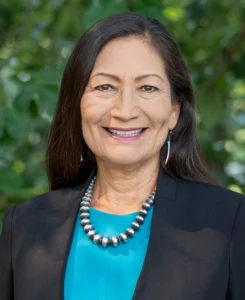
A champion for Indigenous rights, missing women and children, and environmental rights, the Honorable Deb Haaland is a dynamic and tireless changemaker who continues to fight for what she believes in: equity and justice.
Deb Haaland was born in Arizona to John Haaland, a 30-year Marine Corps veteran who earned two Purple Hearts in Vietnam, and Mary Toya Haaland, a Navajo veteran of the U.S. Naval Reserve who later spent 25 years at the Bureau of Indian Affairs. Interestingly, when her mother played snare drum in the Santa Fe Indian Band, she traveled with that band as a girl to Washington, DC to perform at President Dwight Eisenhower’s inauguration. That visit may have sparked something in her daughter at an early age.
Deb Haaland grew up with the typical instability of a military family. Known as Crushed Turquoise to the Pueblo people, Ms. Haaland was largely influenced by her maternal grandparents, Helen and Antonio Toya. Her grandparents gave her a window into the grueling hardships of life as Indigenous people in the US. Their one room home on the Laguna Pueblo reservation in New Mexico exposed her to Indigenous customs and traditions. Attending 13 public schools before graduating from high school and learning more about her people’s struggle for sovereignty would later fuel Ms. Haaland’s activism, as she fought for Indigenous land and human rights.
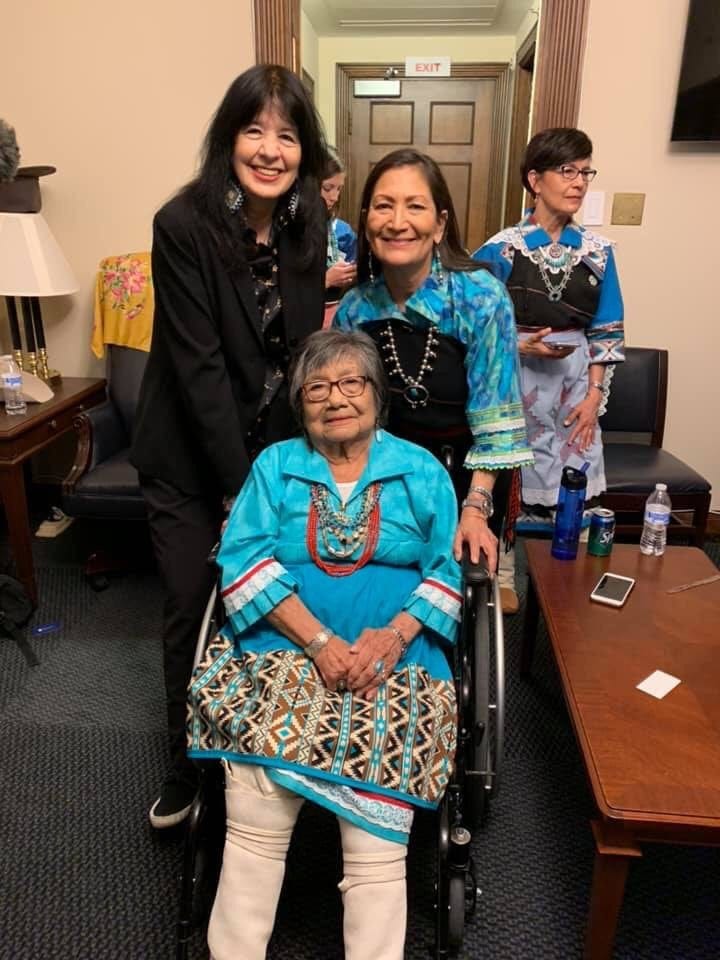
Deb Haaland’s mother shown here with her and Joy Harjo, the first Indigenous Woman Poet Laureate.
Debra Haaland’s life after high school was fraught with hardship. Not only did she struggle to make a living, but she also battled addiction and became a single mother. Her daughter was born right after Ms. Haaland received her bachelor’s degree from the University of New Mexico. Sober since 1988, she nevertheless experienced the challenges that so many of her people still do: relying on food stamps and Planned Parenthood for healthcare. She had first-hand experience of the very issues she would later address in her advocacy work for working families and Indigenous women.
Deb Haaland became an entrepreneur when she launched Pueblo Salsa, a small business canning traditional recipes. She began working in local governance, serving as administrator and casino manager for the San Felipe Pueblo from 2013 to 2015 and becoming the first woman elected to chair the Laguna Development Corporation’s board. Ms. Haaland advocated for sustainable business practices and protected sacred lands from over-development, echoing back to what she had learned from her grandparents.
Her political activism started on the ground, lobbying for candidates who shared her values. While earning her law degree from the University of New Mexico School of Law, she volunteered on campaigns for John Kerry and Barack Obama, eventually organizing Indigenous voter outreach for President Obama’s 2012 reelection in New Mexico. She became chair of the New Mexico Democratic Party from 2015 to 2017, the first Indigenous woman to lead a state party. In that role, she prioritized Indigenous votes and flipped the New Mexican House.

But her true political clout came when she stood with water protectors opposing the Dakota Access Pipeline. She spent four days at the 2016 Standing Rock protest, cooking tortillas and acting as a bridge between protest camps and policy meetings. Once home, she ensured the party’s divestment from Wells Fargo, a pipeline financier, and supported treaty rights and clean water. These efforts drew national attention to the violent impact of fossil fuel extraction on Indigenous lands.
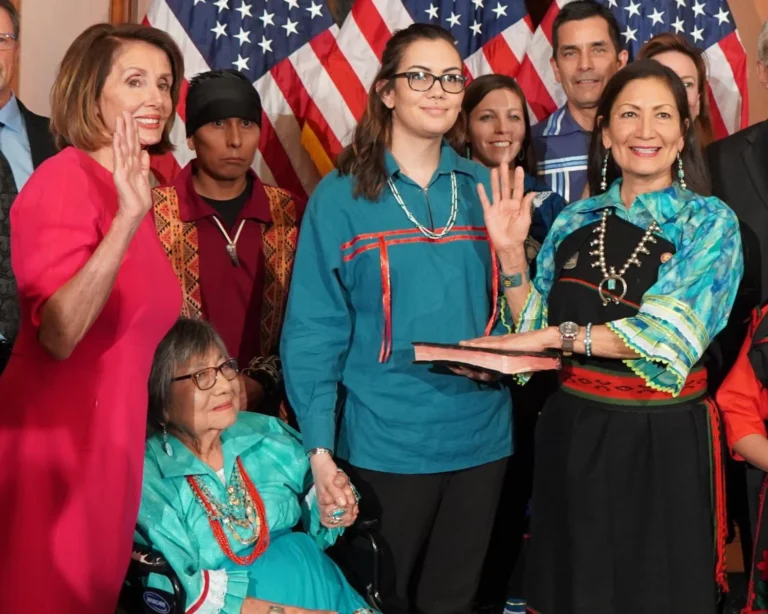
Nancy Pelosi, Deb Haaland and her mother and daughter
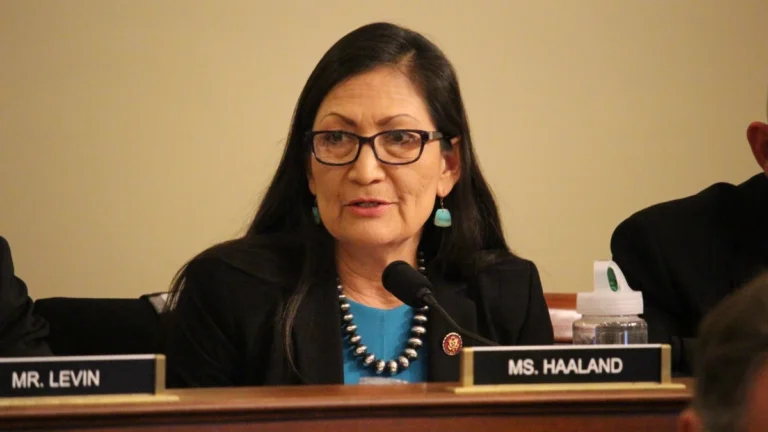
Deb Haaland made history in 2018 when she, along with Sharice Davis, became one of the first two Indigenous women in Congress. She chaired the House Natural Resources Subcommittee on National Parks, Forests, and Public Lands and had an impressive legislative record, with more bipartisan co-sponsors than any 2019 freshman and seven bills signed into law. “I promise I will fiercely represent all of us. I will represent the rich fabric of diversity that has made our country a beacon to the world for more than 240 years.”
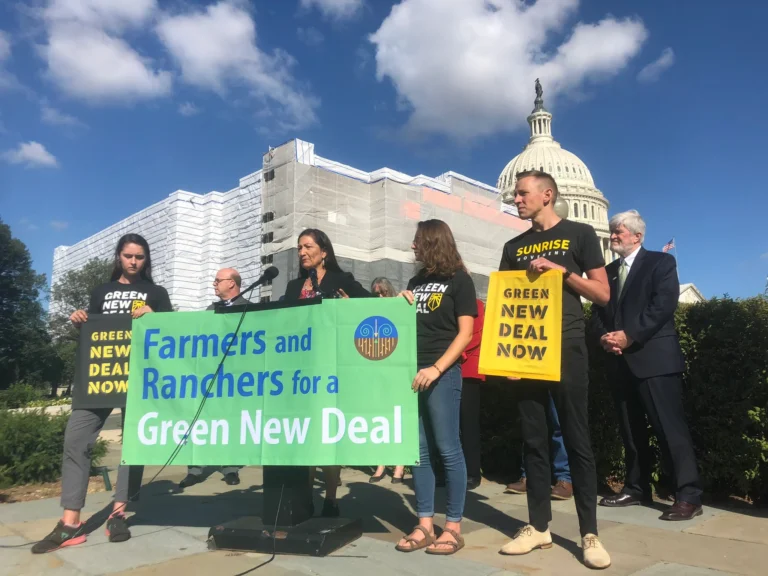
Congresswoman Haaland focused on the environment and human rights. She co-sponsored the Green New Deal and was able to help obtain relief during the pandemic for Indigenous people. She fought hard against family separation at the border and reminded the public about the horrors Indigenous children had been subjected to in boarding schools. She advocated for dedicated federal investigations into the huge numbers of missing and murdered Indigenous women. Conducting voter registration drives in pueblo halls, she promoted voting rights. Her lobbying for Medicare for All and COVID-19 equity for Indigenous people led to her being re-elected in 2020: “Native women rarely held Federal leadership positions,” she told Congress “and now little girls everywhere will know that they can run for Congress and win.”
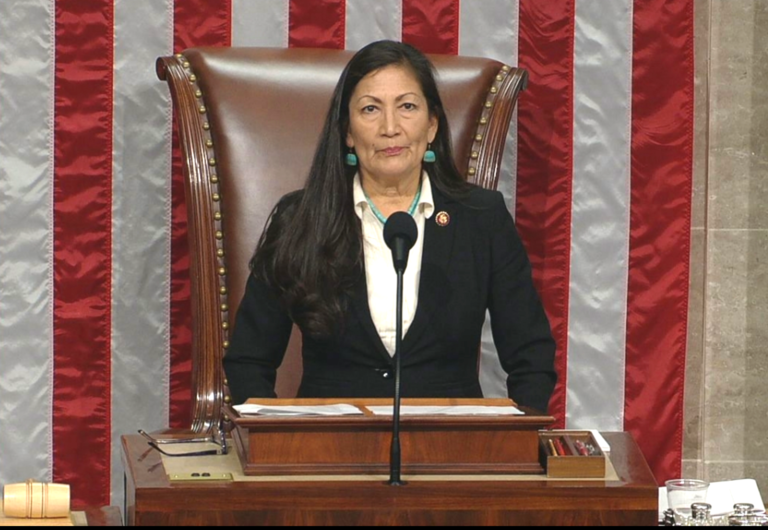
Deb Haaland is the first Indigenous woman to sit and speak in the Speakers Chair in the US Congress.
In March 2021, Ms. Haaland made history again when she became the first Indigenous Cabinet Secretary, Secretary of the Interior. Ms. Haaland transformed the Department of the Interior, overseeing 70,000 employees and 574 federally recognized tribes. She created the Federal Indian Boarding School Initiative in 2021, documenting abuses in nine states at over 400 institutions that killed nearly 1000 children, according to the most recent reports. Children were beaten, not allowed to speak their native language, exploited as child laborers, malnourished and abused. Ms. Haaland’s own grandparents had suffered through those horrific conditions and shared their experiences with her. She was determined that the truth come out to the world.
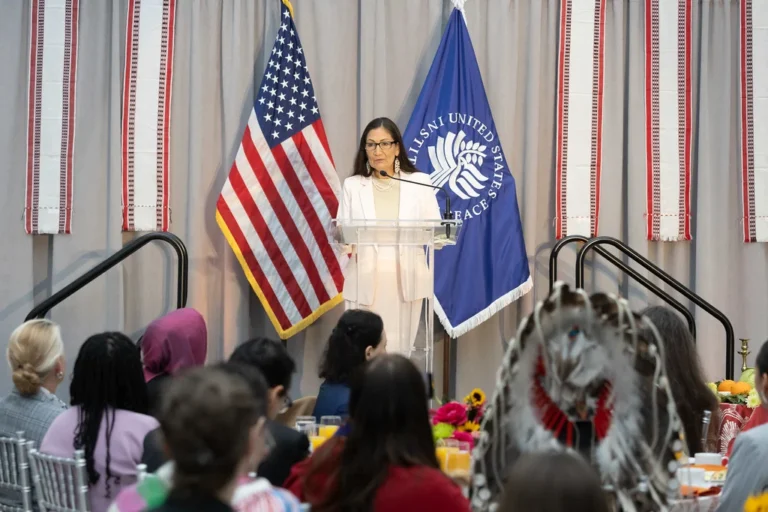
Photo credit: US Institute of Peace Gathering of Indigenous leaders.
A staunch advocate of conservation, Secretary Haaland promoted the “30 by 30” conservation goal, restoring protections for the Bears Ears and Chaco Culture monuments which were sacred to the Laguna people, and blocking new oil leases at cultural sites. A major initiative provided electricity to 16,000 unelectrified Indigenous homes using clean energy.
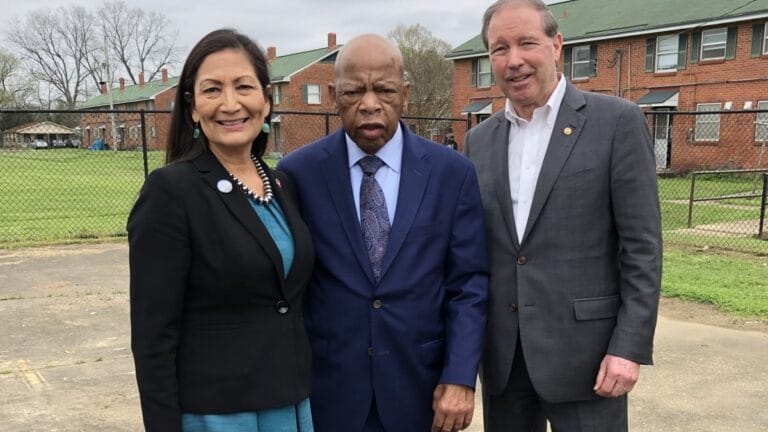
Deb Haaland with John Lewis and Tom Udall on a Civil Rights Tour
With pride in her heritage, Deb Haaland issued Secretarial Order 3404 to remove derogatory language about Indigenous people in 650 locations. She also fought to keep the Indian Child Welfare Act. She retired as Secretary of the Interior when President Trump took office. Not willing to give up her strong advocacy work, in February 2025, Deb Haaland announced that she would run for governor of New Mexico in 2026.
A genuine shero, Deb Haaland has consistently taken a stand for her people with quiet fortitude and unwavering determination. A 35th-generation New Mexican whose life is a tribute to her ancestry, Deb Haaland continues to advocate for:
- the rights of Indigenous people
- environmental protection
- sustainable business practices
- access for all to electricity and clean water
- abused and murdered Indigenous children
- murdered and missing Indigenous women

Lessons from Deb Haaland’s Life:
You can reinvent yourself at any age. Ms. Haaland earned her bachelor’s degree at age 34 when she was a single mother. She bravely overcame addiction, and has stayed sober for decades. She even studied for a Masters Degree while serving in Congress.
Representation matters and heals. First, she chaired the New Mexico Democratic Party and then became one of the first Indigenous people to be elected to Congress. As the first Indigenous Cabinet Secretary of the Interior for the United States, Deb Haaland demonstrated the power of tenacity and represented her people with courage, dignity and grace.
Justice also means protecting the environment. Not only did Deb Haaland shine a spotlight on the egregious abuses to Indigenous women and children, she was also able to ban oil leasing near Chaco Canyon. She garnered investments in clean energy, protected sacred lands, and removed derogatory place names.

Action Steps You Can Take:
Demonstrate your support of a clean environment by participating in park or beach clean-ups, organizing recycling drives and passing along items that can be reused.
Learn more about the horrific experiences Indigenous children had to endure in boarding schools and the murder of 1000 children. Share your knowledge with others.
If you notice something odd, like a woman or child disappearing from your community, speak up, ask questions and notify officials. Don’t assume that everything is OK.

Did this article inspire you?
Please share your feedback and share it with others here:
