Supreme Court Justice Ruth Bader Ginsberg
Champion for Your Rights

“Women belong in all places where decisions are being made. It shouldn’t be that women are the exception.”
Ruth Bader Ginsberg
Supreme Court Justice Ruth Bader Ginsberg was an extraordinary woman and a fearless, tenacious advocate for women’s rights. Your ability to open a bank account, get a mortgage, access state-funded education and keep your job while pregnant are all due to the work of the brilliant Ruth Bader Ginsberg. She was a quiet, collaborative changemaker who truly impacted the lives of every woman in the United States.
Born to working class parents in Brooklyn, New York, Joan Ruth Bader grew up with deep respect for civic responsibility and learning. Her mother, Celia Bader, taught her daughter the values of independence and fairness, encouraging young Ruth to be strong and independent. Those traits persisted throughout Ms. Ginsberg’s life. Sadly, her mother died of cancer right before Ms. Ginsberg graduated from high school, where she had excelled. That excellence earned her a full scholarship to Cornell University, where she graduated at the top of her class with a B.A. in government. At Cornell, she met her future husband, Martin Ginsburg, who supported her career every step of the way. Their marriage was based on a deep love and appreciation of each others’ gifts. Knowing she could not cook, he took over the meals and even learned French cooking.

After her husband served in the military and she gave birth to their daughter Jane, Ms. Ginsburg attended Harvard Law School at a time when very few women did. She faced significant gender discrimination as one of only nine women in her class of over 500, noting that some professors said she was taking the seat a man should have had. Serving on the Harvard Law Review as a student and mother, multi-tasking became her forte when her husband Martin faced testicular cancer. Her deep love shone as she attended his classes as well as her own and took notes for both, typed his papers and made sure he graduated as well. After transferring to Columbia Law School for her final year, she amazingly tied for first in her class.
While Marty Ginsberg became a formidable lawyer and nationally recognized tax law expert, his wife Ruth Ginsberg had a difficult time finding a job. Denied Supreme Court clerkships because she was a Jewish woman, she finally got a judge clerkship and worked as a research associate on international procedure at Columbia. She became an assistant professor at Rutgers Law School in 1963. Hiding her second pregnancy with her son to keep her job, she earned tenure. That experience impacted her lifelong dedication to breaking down gender-based legal barriers and protecting women at every stage of their careers.

Ruth Bader Ginsburg’s most significant work in social justice work started in the 1970s, when she helped redefine sex discrimination as a constitutional issue. She co-founded the Women’s Rights Project at the American Civil Liberties Union in 1972, arguing 6 landmark gender equality cases before the Supreme Court, five of which she won by arguing that decisions on the basis of sex violated the Equal Protection Clause of the 14th Amendment. She shrewdly represented male plaintiffs to win her arguments, knowing this would be more accepted. As she said, “Fight for the things that you care about. But do it in a way that will lead others to join you.”
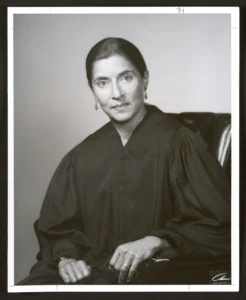
photo from the Univ. of Ga. School of Law where Ms. Ginsberg spoke
Ruth Bader Ginsburg systematically destroyed laws based on gender stereotypes, making great strides in equality for women in terms of family law, employment, benefits, and jury duty.
In 1980, Ruth Bader Ginsburg was appointed by President Jimmy Carter to the U.S. Court of Appeals for the D.C. Circuit. Working there for 13 years, she became known as a centrist liberal who collaborated and worked well with conservative opponents. Throughout her work, Marty Ginsberg continued to advocate for his wife, lobbying for her Supreme Court nomination.

Learning of her innovative approaches, President Bill Clinton was so impressed that he nominated Ms. Ginsburg to the Supreme Court in 1993. The Senate confirmed her with only three opposed, and she joined Sandra Day O’Connor as the only two women on the court at that time. Justice Ginsburg continued to fight for all people, addressing all types of discrimination, including race and disability. Using intellectual and social savvy, she consistently rewrote her Supreme Court drafts with the intention of creating consensus, believing that lasting social change came from sound decisions that were apolitical.
Her dissenting opinion in Ledbetter v. Goodyear Tire & Rubber Co. brought national attention to pay discrimination against women and directly led to congressional action: the Lilly Ledbetter Fair Pay Act of 2009. As a result of her work, women were able to open bank accounts and obtain mortgages in their own name, have credit cards, access state funded education, and stay employed while pregnant. Many of these rights did not come about until the mid 1970’s.
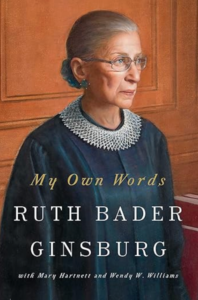
Justice Ginsberg carefully crafted her public persona later in life, wearing distinctive judicial collars, firmly establishing women’s rights to serve on the court. The author of over 9 books, Ruth Bader Ginsberg was both deeply articulate and prolific. Her last book My Own Words “showcases Ruth Ginsburg’s astonishing intellectual range” (The New Republic.) An amazingly insightful and powerful public speaker, Justice Ginsberg also spoke lovingly of her beloved husband, Marty, as the “only man who cared that I had a brain.” In fact, he considered his role in supporting her career as the“most important thing I have done”.
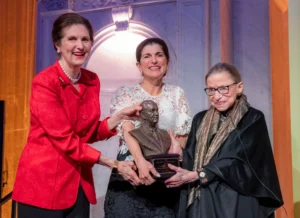
photo by Jay Godwin: Ms. Ginsberg receives the LBJ award
Two films showcased the phenomenal work of Supreme Court Justice Ruth Bader Ginsberg: On the Basis of Sex and RBG, a documentary. RBG showcases Ruth Bader Ginsberg as a person, where you learn of her love of opera, her disciplined workout routines, and her warm sense of humor. A true collaborator, Justice Ginsberg made friends with the enemy, understanding that collaboration is key. Her longtime friendship with Justice Antonin Scalia is one example.
Justice Ginsberg won several prestigious awards for her civil rights and gender equality work, including the Bergguen Prize, the LBJ Liberty & Justice for All Award, and the Genesis Lifetime Achievement Award. She was honored with the Liberty Medal, in a nod to her profound impact on American law and society as a trailblazing jurist and advocate for equality.

Supreme Court Justice Ruth Bader Ginsburg was a quiet, steady and tenacious advocate for gender equality and social justice and her influence endures long after her death in 2020. She actually changed American law, and how differences were treated. A true changemaker and trailblazer, she had a huge impact on civil rights, inspiring ongoing battles for equality for LGBQT+ rights, voter protection, and access to healthcare. Called “Notorious R.B.G.” for her keen wisdom, persistent advocacy and strength despite facing cancer multiple times, she became an iconic symbol for women’s rights and equality. She is a bonafide legend.
Supreme Court Justice Ruth Bader Ginsberg advocated for:
- equality for all, including LGBTQ+
- women’s rights
- civil rights
- women’s economic independence
- voter protection
- equal access to healthcare

Lessons from Ruth Bader Ginsberg’s Life:
Institutions Matter. Justice Ginsberg understood that the only way she could bring lasting change was to work within the system, even when it is frustrating. Her patience and tenacity in working the law, advocating for equality, collaborating with justices on the opposing sides, resulted in decisions that stand through time. As she said, “A constitution, as important as it is, will mean nothing unless the people are yearning for liberty and freedom.”
Restraint is Powerful. A ruthlessly disciplined woman and Supreme Court Justice, Ms. Ginsberg wrote precise decisions specific to each case. She was restrained in her writing, deliberately. She created rulings that could not be dismantled in the future and wrote accordingly. Her dissents were messages for the future, with clear frameworks. Many dissents later became the majority view.
True partnership is powerful and enhances both parties. She had a true marriage of mind and spirit with Marty Ginsberg. They supported each others’ careers fully, pragmatically divided up labor at home, intellectually challenged each other and loved each other deeply. No one partner was more important than the other. As she said to Parade magazine. “If you have a caring life partner, you help the other person when that person needs it. I had a life partner who thought my work was as important as his, and I think that made all the difference for me.”

Action Steps You Can Take:
- Learn systems you want to change. Justice Ginsberg worked within the structures and argued from mastery. For you, this means deeply and clearly understanding the systems and rules of your workplace, industry, or school. Learn how decisions are actually made and leverage that knowledge to advocate for change.
- Resist the urge to fight everything all at once. Yes, there are many upsetting issues today. Pick the one you have great knowledge of, where you have allies and access. Use your energy wisely.
- Build partnerships that are mutually supportive. Justices Ginsburg’s marriage was based on mutual respect for each others’ strengths. Whenever you are partnered with someone on a project or in life, lean on each other’s unique gifts and make the most of them.

Did this article inspire you?
Please share your feedback and share it with others here: