Maggie Lena Walker
A Blueprint for Purposeful Power

“Any woman who has executive ability, who is honest and who has a keen perception and tact in dealing with people can succeed.””
Maggie L. Walker (1909)
An extraordinary changemaker and trailblazer, Maggie Lena Walker left a legacy of vision, leadership and courage, breaking barriers while establishing institutions and policies which uplifted entire communities.
Ms. Walker was born Maggie Lena Draper on July 15, 1864 in Richmond, Va. Her mother, Elizabeth Draper, was a formerly enslaved woman who worked as the assistant cook on the estate of an abolitionist, Elizabeth Van Lew. Her biological father was Eccles Cuthbert, an Irish American. Shortly after Walker’s birth, her mother married William Mitchell, the African American butler on the estate.
When her father died, 11 year old Maggie worked to support the family by doing laundry. She laughed later in her life, saying that “I was not born with a silver spoon in my mouth, but with a laundry basket practically upon my head.”
Ms. Walker was blessed to have a mother who believed in the power of education, and although she needed her daughter’s help and income, she insisted on her daughter going to school. Maggie Lena Walker was among the first Black children to attend Richmond’s segregated system of schools, not an easy experience. The Richmond Colored Normal School was where she attended high school, after competing by exam to attend. There she received a disciplined and challenging education. That led to her to becoming a grade school teacher for three years.
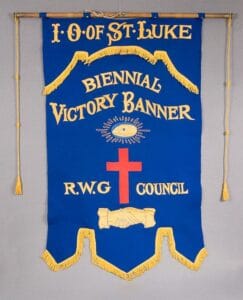
The biggest influence in her professional life was the Independent Order of St. Luke, (IOSL,) a Black fraternal organization dedicated to racial uplift. Founded in 1867 by Mary Prout, the IOSL embraced Maggie Lena Walker. She joined at age 14 and never looked back.
She married Armstead Walker in 1886 and raised two sons. Continuing her work with the IOSL, she became lodge president and then a national deputy. In 1895, Ms. Walker founded the IOSL Juvenile Department, which led to establishing new leadership roles for women. Sadly, her husband was killed in an accident, but she persevered and continued to innovate at the IOSL. At age 35, she took on the mantle of Right Worthy Grand Secretary, the highest leadership role in the order, a role she kept until her death.
This is when Maggie Lena Walker’s expansive vision and commitment to change had a huge impact. Determined to shift the organization to becoming a national force for Black economic empowerment, she transformed the IOSL throughout the country. In thirty years, under the leadership of Maggie Lena Walker, the IOSL’s membership multiplied to more than 100,000 people across 24 states.
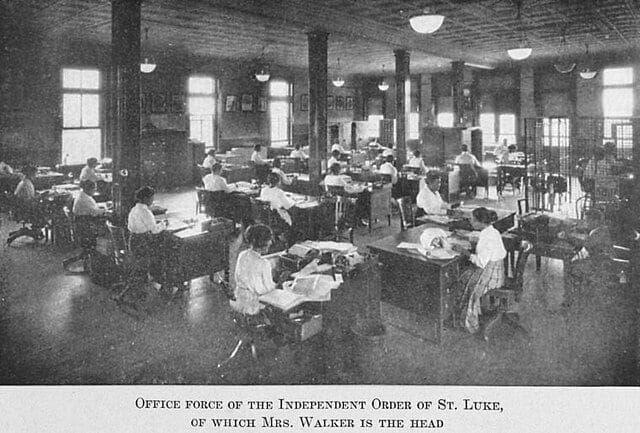
Understanding that mutual support and encouragement was not enough to assist those in need, she innovated ways to help Black people gain control over their economic lives. She established several institutions to make that happen, including the IOSL administrative offices, which provided white collar jobs for African American men and women.
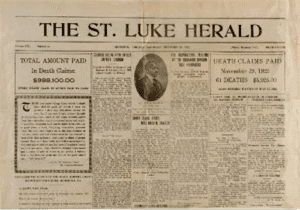
photo from the National Park Service
The first major establishment was a newspaper for African Americans. Publishing weekly from 1902-1931, The St. Luke Herald featured articles to educate and inspire Black communities. During the depression, she shifted to a monthly format called the St. Luke Fraternal Bulletin, which was published for several decades.
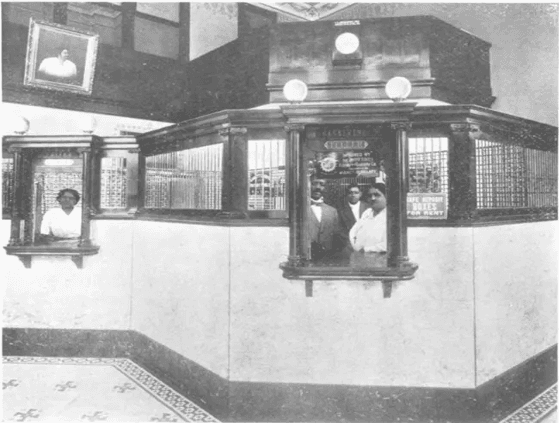
photo from the National Park Service
“What do we need to still further develop and prosper us, numerically and financially? First we need a savings bank, chartered, officered and run by the men and women of this Order. Let us put our moneys together; let us use our moneys; let us put our money out at usury among ourselves, and reap the benefit ourselves.”
In 1903, Maggie Lena Walker made history as the first Black woman in the United States to charter and lead a bank: the St. Luke Penny Savings Bank. Welcoming every level of customers, from the individual who deposited with just 31 cents to those who deposited hundreds of dollars. 280 accounts had been established by the end of the bank’s first day, with over $8,000 in deposits, and $1,000 in investor stock sales. By the mid 1920’s, the bank had helped over 600 families buy homes, with over $500,000 in deposits. She later became Chairman of the board of directors when the bank merged with two others and became The Consolidated Bank and Trust Company. This bank prospered as the oldest continually African American-operated bank in the United States until 2009.
“Let us have a bank that will take the nickels and turn them into dollars.” And Ms.Walker did just that, turning nickels into dollars and dollars into dignity.
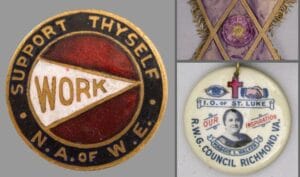
photo from the National Park Service
Maggie Lena Walker continued to support her community and later opened a Black-owned department store, The St. Luke Emporium, which catered to African American customers and had Black staff members. This enabled her community members to shop with ease and comfort.
Maggie Lena Walker was a true visionary, who knew that freedom meant control in every area of one’s life, economic, political, educational, spiritual. She was a champion of girls and women and African Americans, serving as an officer in the National Association of Colored Women, a board member of the National Negro Business League, and a charter member of the Richmond chapter of the NAACP. She served on the Board of Trustees of the Virginia Industrial School for Girls and a member of the Virginia Interracial Commission.
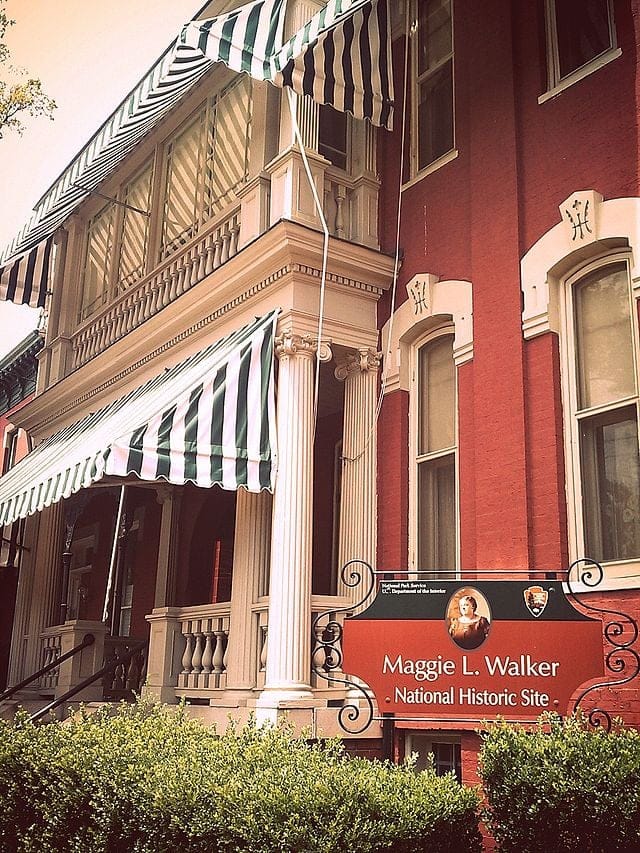
Ms. Walker’s home was purchased by the National Park Service and is now a National Historic Site. Photo from NPS.
Ms. Walker also never quit. Coping with diabetes and partial paralysis in her later years, she kept working until her death while seated in her wheelchair. She held meetings at home, writing speeches and conducting business as Chairman of the Bank and leader of the IOSL.
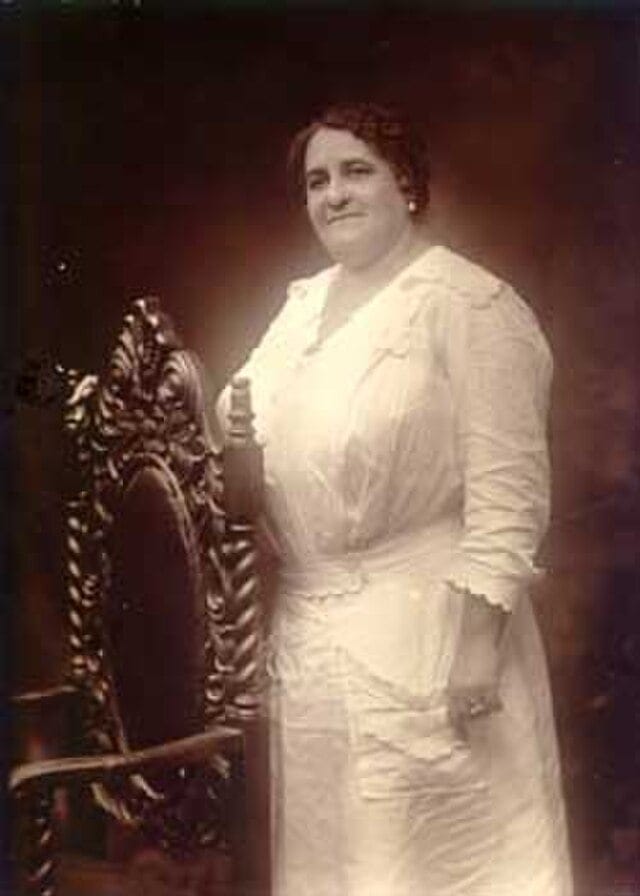
Maggie Lena Walker had a huge influence, not just in Virginia, but nationwide. A dynamic speaker who wove scripture into motivational speeches and ignited action, she met with prominent leaders like Booker T. Washington, W.E.B. Du Bois, and Marcus Garvey. She created real life solutions for her people, understanding that economic empowerment and sovereignty were the keys to true freedom. She encouraged African Americans to have pride in their work and claim their voices in every
aspect of their lives.

Photo of Jackson Ward
In the early 20th Century, Maggie Lena Walker’s vision helped mold Richmond’s Jackson Ward into a thriving area for Black Americans, where they could shop, invest, build and own, and not be subject to the racism and segregation still prevalent in many parts of the country.
What an incredible legacy Maggie Lena Walker left upon her death: a series of successful Black-owned institutions, many of which continued on for decades, dozens of well- trained women leaders, and a clear example of how one woman can make a huge difference.
Throughout her life, Maggie Lena Walker advocated for:
- Equal rights of African Americans
- Economic empowerment and freedom for African Americans
- Equal opportunities and economic freedom for girls and women
- Education for all

Lessons from Maggie Lena Walker’s Life:
• No matter where you came from, you can thrive and excel. Helping to support her family after her father died, Ms. Walker did laundry. Her humble background did not stop her from becoming the first Black woman to open and chair a bank. She became a highly successful leader in the community, lifting others. Your background does not define you.
• Freedom without economic independence is not true freedom. Ms. Walker knew that for the African American population in her community to experience real freedom, they needed economic peace of mind about saving and spending their money. And a way to communicate about it. Hence, she established a newspaper, bank and store. “Let us awake. Let us arise. We have the men, we have the women, we have the brains. Let us form a partnership of heads and brains, and actually do something.”
• A trailblazer and changemaker, she knew that women deserve opportunities equal to those that men have, and she made it a point to educate girls and create white collar roles for women of color. She modeled true leadership and collaboration, and she drew on her emotional intelligence. “Let woman choose her own vocation just as man does his. Let her go into business, let her make money, let her become independent, if possible, of man.”

Action Steps You Can Take:
How can you amplify the impact you have? Can you serve on advisory boards or alumni committees, or increase your engagement in community affairs?
Celebrate the successes of other women visibly, whether in social media or writing about them. When you see another woman has had an achievement, congratulate her publicly. Cheer other women on.
Magnify your work. If you run a small community effort, ask yourself what would it take to expand it and replicate it elsewhere. Create a playbook of how you created it, so that others can do the same. As Maggie Lena Walker did, dream bigger.

Did this article inspire you?
Please share your feedback and share it with others here:
