Madeleine Albright
A Fearless Advocate for Women and Human Rights
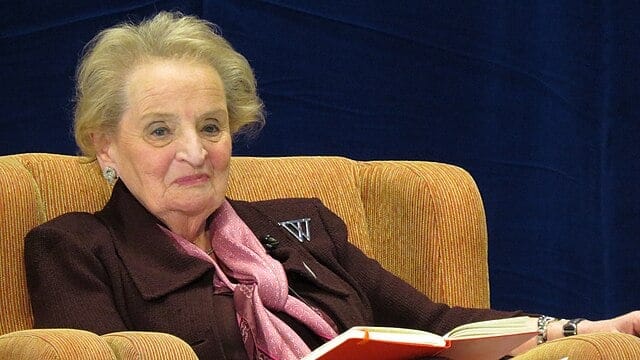
“From Snowden: I had the privilege of hearing Madeleine Albright speak shortly before her death, discussing the dangers of fascism. In her measured eloquence, she was absolutely mesmerizing. Her passion, wisdom and wit made a profound impact upon me. Later, in Massachusetts, I visited the exhibit “Read My Pins,” showcasing her famous brooches used in diplomatic missions with matching stories. It was absolutely fascinating and gave me insight into her brilliant negotiating tactics.
“Community is the glue that holds societies together; without it, we risk fragmentation and despair.”
Madeleine Albright
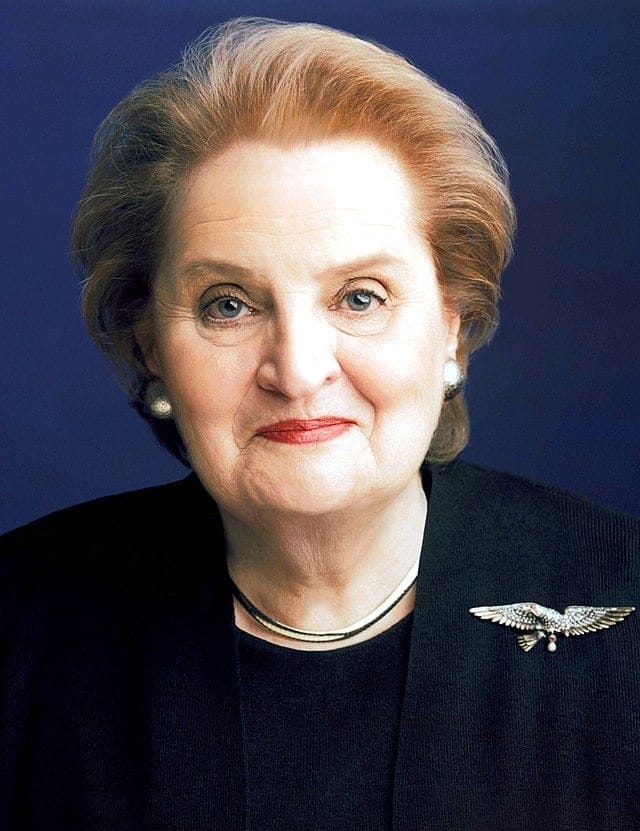
Madeleine Albright, former United States Secretary of State, was an outstanding leader, global changemaker and inspirational peacemaker. A brilliant and decisive diplomat, she had a passionate commitment to freedom and democracy, born from her own experiences escaping facism. A refugee who became one of the world’s most influential international diplomats, her life was a testament to transforming policy into action.
Madeleine Albright, born Marie Jana Korbelová in Prague in 1937, entered a war-torn world. The daughter of Czech diplomat Josef Korbel and his wife Anna, she and her family fled to London during Nazi occupation in 1939, knowing first-hand the terror of occupation and war. After returning home, they had to escape once again in 1948, when their belief in democracy put them in opposition to Communist leaders. Those experiences forged her powerful commitment to human rights and freedom from oppression

After seeking asylum in the United States, the family made a home in Denver. Colorado. By age 11, Ms. Albright had lived in several countries and spoke four languages, but her parents’ strict European upbringing made it difficult for her to adapt to the more flexible American mores. After graduating from Kent Denver School, a college preparatory school, she attended Wellesley College, earning a B.A. in political science. In 1957, she became a U.S. citizen.
While at Wellesley, she met her future husband, Joseph Medill Patterson Albright, a newspaper reporter and heir. Married right after her graduation, the couple had three daughters. While raising her family, Ms. Albright obtained advanced degrees in international relations at Georgetown University and Johns Hopkins University’s School of Advanced International Studies. Knowing that she wanted a career in government, she earned a master’s degree and Ph.D. in Public Law and Government from Columbia. These studies prepared her well for her future career.
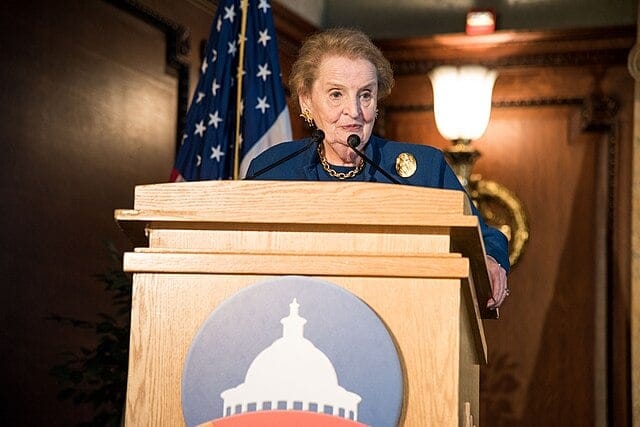
The family moved to Washington, D.C. in the late 1960’s, and later Madeleine Albright entered politics on the ground level as a fundraiser for Senator Edmund Muskie’s 1972 presidential campaign. This experience led to her appointment as Muskie’s chief legislative assistant, where she learned the ins and outs of Congress. Her former Columbia professor, Zbigniew Brzezinski, recruited her for her position at the National Security Council as a staff member under President Jimmy Carter. There she served as a liaison with Congress on foreign policy matters. This experience proved to be invaluable later in her career.
Ms. Albright transitioned to academia and nonprofit work during President Reagan and President George Bush Sr’s. administrations. From 1982 to 1993, she was Research Professor of International Affairs at Georgetown University’s School of Foreign Service, where she also directed the Women in Foreign Service Program and encouraged women to enter the field. A staunch advocate for women, she taught simulations of possible foreign affairs issues to women students. One of those students was Condoleezza Rice.
During this era, her Georgetown townhouse was the site of many meaningful gatherings of Democratic leaders. She provided foreign policy advice for several democratic presidential hopefuls, and in 1992, she was part of President Bill Clinton’s presidential transition team. Through her expertise, connections and experiences, Madeleine Albright was uniquely positioned to be a prominent figure in foreign relations for decades to come.
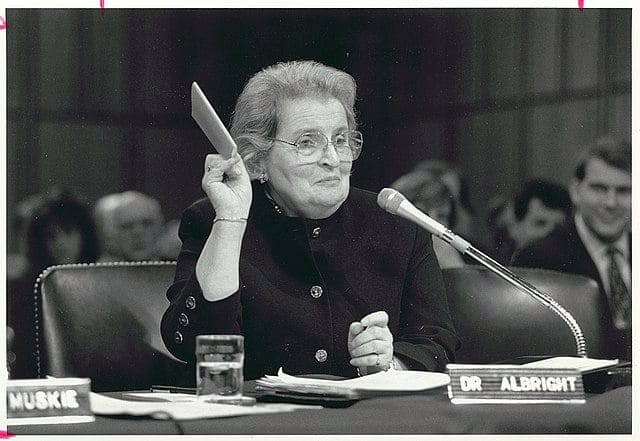
In 1993, she was appointed U.S.Ambassador to the United Nations. Here Ms. Albright was particularly focused on advancing women’s rights and human rights via international policy. She lobbied hard for U.N. resolutions addressing violence against women. She promoted greater female participation in peacekeeping missions, knowing that gender equity was critical to global stability. Madeleine Albright also understood that women’s emotional intelligence could be especially effective in negotiations. As she lobbied for sanctions against authoritarian regimes, her work at the U.N. was a shining example of social activism within the context of governmental structures.
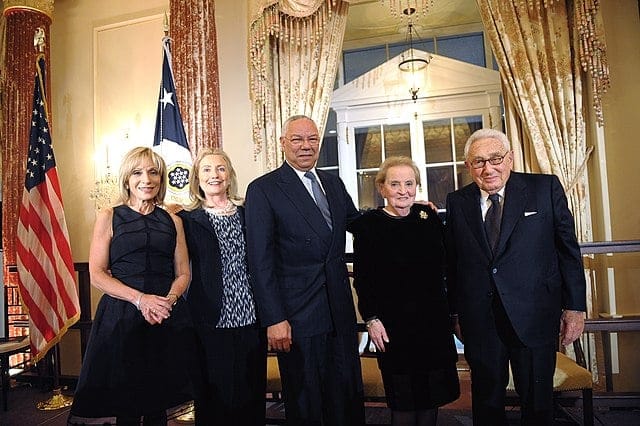
In 1997, Madeleine Albright made history as the first woman to serve as U.S. Secretary of State, under President Bill Clinton. A fierce advocate for women’s rights and human rights, she blended diplomacy with a practical approach to negotiation and foreign relations. In 1999, she led the Kosovo intervention to stop ethnic cleansing, something she was all too familiar with when her family escaped the Nazis. Ironically, that same year, although she was raised Roman Catholic, she discovered that her heritage was Jewish. Through her connections to some of her relatives, including three grandparents who had died in the Holocaust, learned she was Jewish. That knowledge made her work protecting the vulnerable even more personal to her.
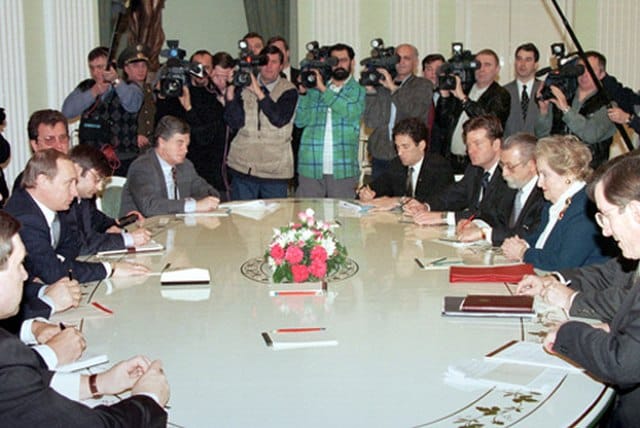
Ms. Albright is especially remembered for her staunch advocacy for women. She carefully wove women’s issues into trade negotiations, promoting labor standards to address gender inequality. Her statement in 1996 “there is a special place in hell for women who don’t help other women,” increased her female following worldwide. Her tenure as Secretary of State reframed foreign policy to prioritize human rights, whether dealing with Kosovo, Bosnia or Russia. Her view about the connections between human rights and women’s rights is summarized in her statement: “Women’s rights are human rights, and human rights are the foundation of any just community.”
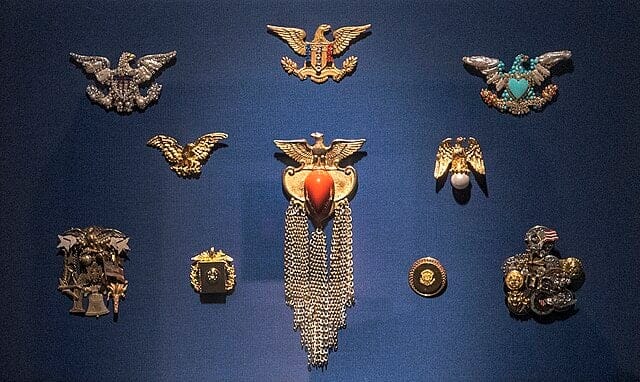
One of the insights into Ms. Albright’s clever mind and sense of humor was demonstrated through her brooch collection, which she deftly employed at each diplomatic meeting. If she suspected the world leader she was negotiating with was being deceptive, she wore a snake pin. She wore that pin often in meetings with Iraqi officials.
When negotiating with Russian Foreign Minister Igor Ivanov, she wore a pin that resembled arrows. He asked Ms. Albright whether the pin she was wearing was one of the U.S. interceptor missiles. She replied “Yes, and as you can see, we know how to make them very small. So you’d better be ready to negotiate.” A playful tool with meaning, the pin symbolized strength and warning. When advocating for women, she wore “The Suffragette Pin,” which is green, white and violet, representing hope, purity, dignity.
In August 2024, the National Museum of American Diplomacy (NMAD) opened Read My Pins: The Madeleine Albright Collection, an exhibit featuring a selection of stories and pins from Secretary Albright’s famed collection.

When Ms. Albright left office, she continued her social activism through founding the Albright Stonebridge Group in 2001, which provided consulting services on ethical business practices in emerging markets, prioritizing democracy and human rights. She worked to promote democracy globally as chair of the National Democratic Institute, and as co-chair of the 2007 Genocide Prevention Task Force. She led the Women in Global Politics program at Georgetown, that involved mentoring future women leaders. A tireless champion of democracy, social justice and human rights, she served on the board of the Council on Foreign Relations and as honorary chair of the World Justice Project.
Madeleine Albright’s continued activism was expressed through her public speaking engagements and writing, warning against authoritarianism and fascism. Her three books, Madame Secretary, Fascism: A Warning, and Hell and Other Destinations chronicled her advocacy for women’s political inclusion and warned about the dangers of totalitarianism. She believed that democracy requires the engagement of all of the people in day to day governance. She said democracy “…is not a spectator sport. It requires the active participation of every citizen.”
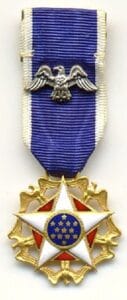
Honored with the Presidential Medal of Freedom in 2012 and inducted into the National Women’s Hall of Fame, she remained a staunch proponent of democracy, human rights and women’s rights until she died in 2022.
Ms. Albright’s work, indelibly marked by her own survival of oppression, her keen intelligence and passionate advocacy, had global impact.
Throughout her life, Madeleine Albright advocated for:
- Human rights
- Women’s rights
- Democracy
- Social justice

Lessons from Madeleine Albright’s Life:
Democracy Demands Citizen Participation: Ms. Albright believed that democracy thrives only through collective action and committed citizens. In Fascism: A Warning, she warned readers that authoritarianism flourishes when people remain silent and passive. As she said, “Fascism thrives when good people do nothing; activism is the antidote to apathy.”
Champion Women’s Rights As a trailblazing political leader, Ms. Albright believed that empowering women is critical to global stability. Through integrating gender perspectives into U.N. policies and mentoring women leaders at Georgetown, she demonstrated that gender equity is both right and smart.
Let Your Personal Experience Fuel Your Purpose Madeleine Albright drew from her personal experience of fleeing oppression in Czechoslovakia twice into a mission to promote freedom and social justice around the world. She warned about authoritarianism in her book Fascism and she championed human rights throughout her life.

Action Steps You Can Take:
Even at the height of her career, Madeleine Albright kept studying and questioning.
• Commit to learning something new each month. Then, share what you discover with your others around you.
• What life experience of yours has fueled your passion? How could you share it more fully?
• How do you engage civically? Do you volunteer for causes you believe in, work to get the vote out, protest injustice? As Madeleine Albright said: “Activism is about courage—courage to speak out, to challenge injustice, and to keep going even when the odds seem impossible.”

Did this article inspire you?
Please share your feedback and share it with others here: